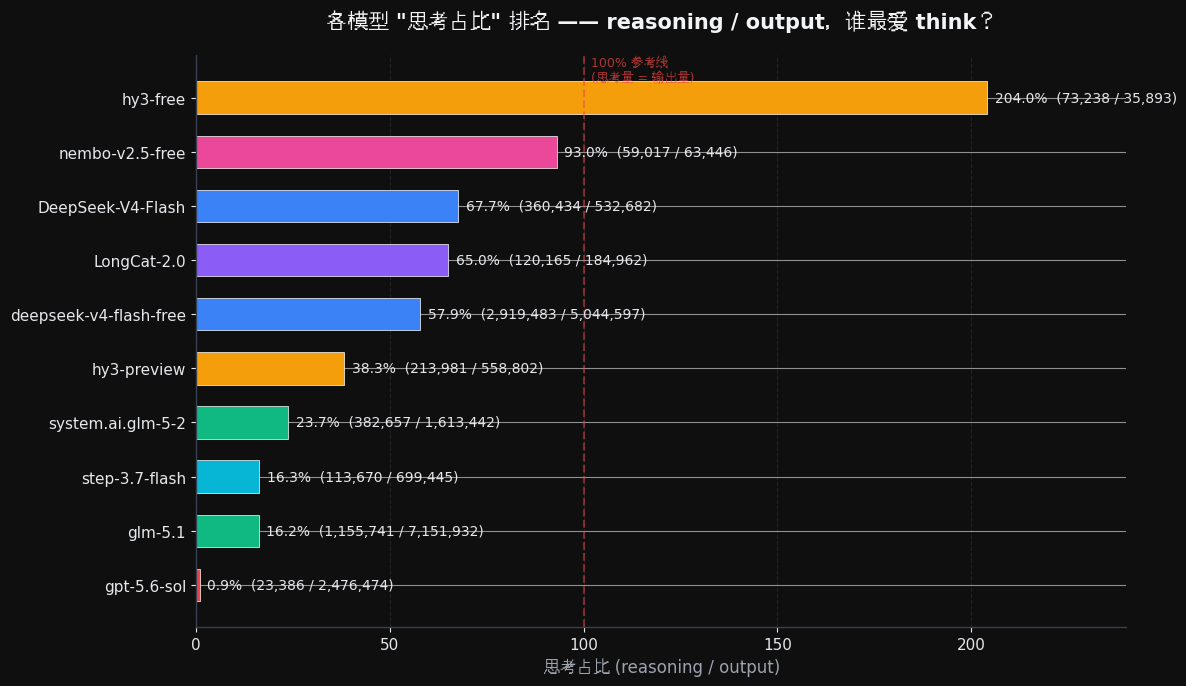
RT, I get the feeling that Microsoft Copilot’s GPT 5.6 Reasoning may be a model specifically designed and fine-tuned for agents.
Because its CoT (chain of thought) is almost entirely structured thinking, something like this:
Title (determine the intent category)
Body (clarify the next action)
It’s like writing an operation log for your own next action—a steady stream of steps—rather than the rambling thoughts of typical models. Let’s compare
Traditional extended reasoning: “I need to check the connection pool now. Let me think—the Take and Warm behaviors in the connection pool might affect TTFB, so I’ll first use the shell to check the logs. Also, PreheatPool needs attention…” (verbose and difficult to parse)
Agent-structured reasoning:
Title (determine the intent category)
Body (clarify the next action)
**Deciding next action**
It seems like the task requires inspecting the connection pool and its warm-up criteria. I'll proceed with executing the shell tool to inspect the connection pool logs.
The benefits are faster responses, strong parsability, and lower token usage, which works very well in agent environments.
The downside is sacrificing depth of thought, which may make the model appear less intelligent. For the model, the tolerance for errors is low (because it cannot repeatedly correct itself, think things through, or change direction). It may perform poorly on mathematics and deep-reasoning tasks.
The above is entirely my own speculation. It does not represent the model’s actual training objectives, nor does it mean that the model’s chain of thought (CoT) is completely like this. It is also possible that this is an overview produced by further processing of the model’s output.
It’s a bit like the GPT offered by Perplexity: even with deep thinking enabled, it basically starts outputting after thinking for just five or six seconds. Very fast.
It’s good at handling tasks, but the task planning isn’t great. The answers are simple, even for medium-level questions they’re very fast, and the experience feels smooth.
Sometimes it just can’t recognize local files. There are also issues with session switching, like forgetting the context or mixing up sessions. But overall, I’m pretty tolerant when it comes to free tokens.