2011 newspaper article, original wording:
Main headline: Seeing “the Flying Man,” they shout “Secretary Liu”
Subheadline: Liu Xiang makes his first appearance as a Youth League cadre and has a strong leadership presence
Comprehensive report from this newspaper: “The Flying Man” Liu Xiang acquired a new identity overnight—the deputy secretary of the Communist Youth League Committee of the Shanghai Municipal Sports Bureau. On the evening of October 29, when Liu Xiang attended an association gala for the first time in this capacity and read an initiative to the athletes present, people below the stage were almost all taken by surprise. However, this did not mean that Liu Xiang had become an official: he was not a division-level director, did not need to work regular office hours, and was certainly not a civil servant. Li Yuyi, director of the Shanghai Municipal Sports Bureau, explained: “We are simply following the fine tradition of the Youth League organization’s recommendation of outstanding young talent.”
New identity kept “secret” for three months—even Liu Xiang’s father knew nothing
“It wasn’t something that happened overnight. In fact, Liu Xiang was recommended as a member of the Shanghai Municipal Sports Bureau Youth League Committee in June this year, and was elected deputy secretary of the committee together with Olympic swimming champion Le Jingyi. We simply did not announce it publicly through the media. There are only five deputy secretaries in total: apart from one full-time deputy secretary, the other four are part-time.” Liu Xiang explained.
A relevant official from the Shanghai Municipal Sports Bureau explained.
Even so, Liu Xiang’s identity as “deputy secretary of the Youth League Committee” was kept very “secret” over the past three months—even Liu Xiang’s father, Liu Xuegen, knew nothing about it. “I didn’t know about it before either; I only heard it from you,” Liu Xuegen said in a media interview on September 30. “But it will be helpful to him. It can encourage him to pay more attention to his studies, set an example, and motivate more young people.”
He interacted while reading the initiative—the Flying Man had a strong “Secretary” presence
Liu Xiang’s task that evening was to issue an initiative to the young athletes at the National Games before the social gathering began. Wearing a simple blue T-shirt and jeans, Liu Xiang stepped onto the stage, and the sight of him—and his “younger brothers and sisters”—prompted cheers throughout the venue.
Liu Xiang read the initiative in an impassioned voice, encouraging Shanghai’s athletes to strive hard and win glory for the country. He urged them to work hard to fulfill the goals they had set and bring honor to the motherland, including “knowing honor and shame, learning etiquette, practicing civility, promoting the spirit of selfless dedication, being scientific and pragmatic, studying diligently, never giving up, tenaciously striving, carrying forward the Chinese sporting spirit, cooperating as a team, and keeping everyone inspired to pursue ‘higher’ goals.”
Because the initiative was rather formal, he also made a point of interacting with the audience. When someone laughed, he deliberately stopped and asked helplessly, “Where did I read it wrong?” At first, Liu Xiang even raised his voice to ask the audience, “Does everyone have confidence?” After the crowd shouted “Yes” in unison, he asked again in an even louder voice, displaying considerable poise. Later, Liu Xiang happily announced on his Weibo account: “I just read an initiative on behalf of the Sports Bureau Youth League Committee! Cheering on and encouraging the Shanghai athletes taking part in the City Games and the Olympic Games!”
This deputy secretary is not an “official”: no rank and no regular office hours
How will Liu Xiang perform as “deputy secretary of the Youth League Committee”? Will this mark the beginning of his political career? The Shanghai Municipal Sports Bureau explained that, strictly speaking, Liu Xiang is not an official. “He remains an athlete, will not be a civil servant, and has no administrative rank. He will participate in some activities, but will not work regular office hours.”
The Shanghai Municipal Sports Bureau Youth League Committee said that, in his role as deputy secretary, Liu Xiang’s main duties would involve communicating with athletes, holding discussion sessions and lectures for young athletes, and using his own experience and achievements to inspire young people. “As an outstanding athlete serving as a Youth League secretary, he can play an exemplary and leading role among young athletes.”
Liu Xuegen also said that Liu Xiang had previously focused more on his personal development. “Now that he has become deputy secretary of the Sports Bureau Youth League Committee, he needs to study and understand policies in various areas more thoroughly. The key is still to improve his conduct, self-cultivation, and personal bearing, set an example in these areas, and make a greater contribution to sports.” (Xinhua News Agency)
News subheadline: Shanghai Sports Bureau: This is not to put him into politics
Liu Xiang’s team: He will not go into business either
This newspaper’s report: Li Yuyi, director of the Shanghai Municipal Sports Bureau, said that Liu Xiang’s appointment as deputy secretary of the Youth League Committee was not a so-called “promotion” intended to make him an official. Rather, the Communist Youth League is inherently an organization that brings together outstanding young talent. “We already have the finest talent in the sports system, so naturally they should be the backbone of this group and lead young people forward.”
There have long been numerous examples of retired athletes entering politics, and it has also become increasingly common for athletes to hold “part-time” positions in government departments. For example, Olympic women’s tennis champion Liu Jun, who was elected deputy secretary of the Shanghai Municipal Sports Bureau Youth League Committee together with Liu Xiang, sent the athletes an encouraging congratulatory letter on the evening of September 29, despite being abroad for training. Table-tennis star Wang Liqin has also taken up the position of deputy director of the Shanghai Table Tennis and Badminton Sports Center.
“We will not arrange any next step for Liu Xiang. We will take it one step at a time. We believe Liu Xiang’s future will not be limited to the track and field arena. Anyone capable of winning world championship or Olympic titles has talent. Appropriate involvement in some affairs and contact with society will not only fail to affect training, but will also benefit athletes’ growth. As long as he is willing to participate and those around him support his development, he will contribute to his future career.” Li Yuyi said.
It is understood that although his future within the system several months from now has not yet been determined, Liu Xiang has already made plans for his future after his professional athletic career. Members of Liu Xiang’s team said, “He will not go into business. At present, he is inclined to enter sports education and use his influence to do something for Chinese sports—whatever he does will definitely be related to sports.” (Chu Meng)
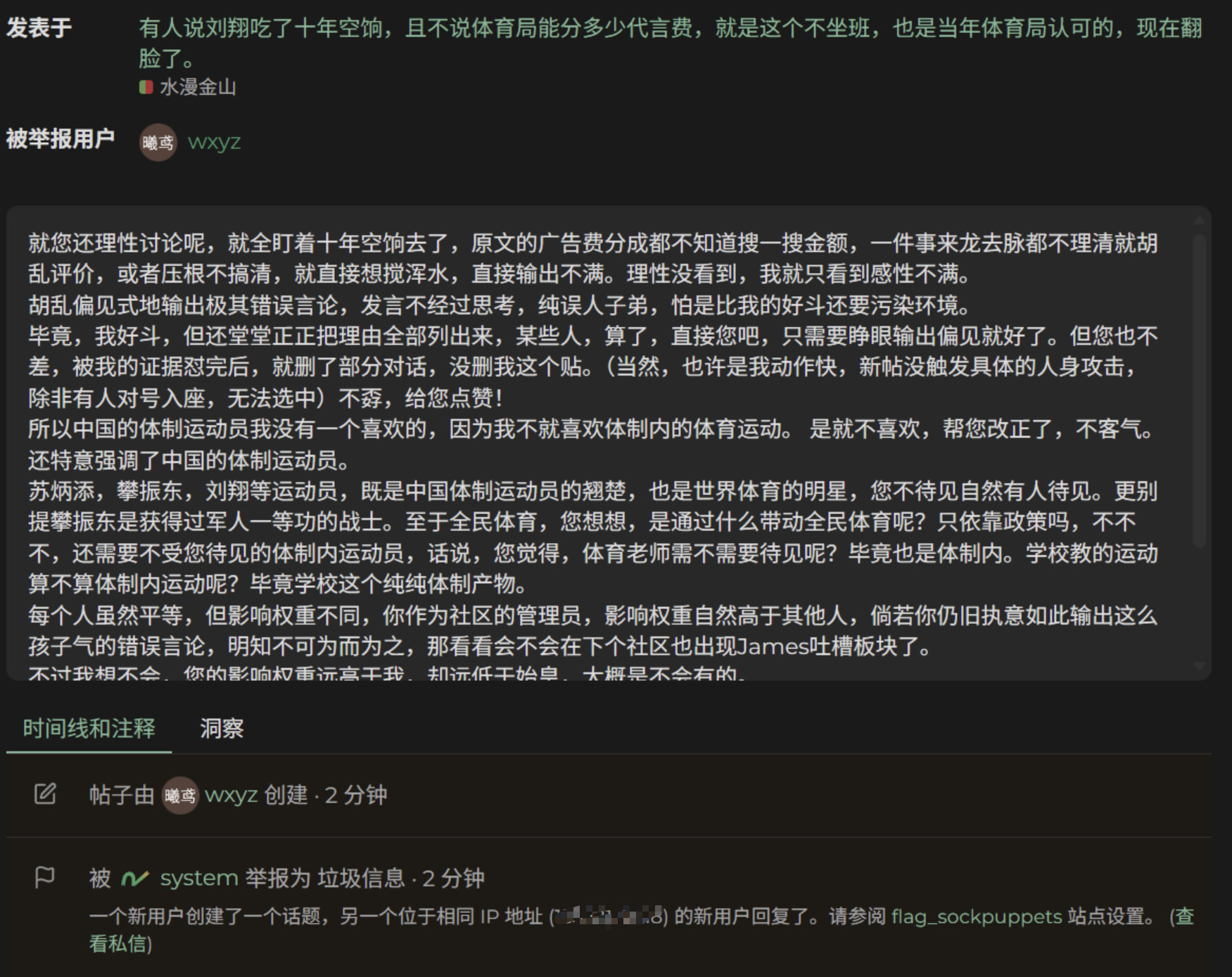
It seems that even more than a decade after Liu Xiang’s retirement, the haters still can’t let it go. Anyone with even a little sense knows that the value Liu Xiang, this thoroughbred racehorse, brought to Chinese sports as a whole far exceeded the cost of training him and the ten years of pay he received while doing nothing.
Fan Zhendong and Zhu Ting have left, but it doesn’t matter—we still have Wang Chuqin and the national football team’s sea-cucumber squad! And there’s Li Tie in prison, singing “Tears Behind Bars.”
I’ve used some pretty harsh language. Guess whether someone will use their private power to ban me 
 Personal attacks.